
Additives
How additives affect PVC properties?
PVC resin obtained from polymerization is extremely unstable. This is due to its low thermal stability and high melt viscosity. It needs to be modified before processing into finished products. Its properties can be enhanced or modified by adding several additives.
Plasticizers
Plasticizers are used as softening agents. Some examples include Phthalates, Adipates, and Trimellitates, to name a few. These additives enhance the rheological properties of vinyl products by raising the temperature. They are also added to increase mechanical performance such as toughness and strength.
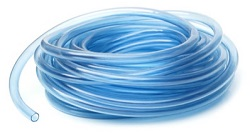
Flexible PVC Pipe
PVC has very low thermal stability. Stabilizers help prevent the degradation of polymer during processing or exposure to light. When subjected to heat, vinyl compounds initiate a self-accelerating dehydrochlorination reaction. These stabilizers neutralize the HCl produced enhancing the life of the polymer. Factors to consider while selecting heat stabilizers are:Technical requirements, Regulatory Approval, and Cost
Fillers are added to PVC compounds for a variety of reasons. Today, a filler can be a true performance additive by delivering value in new and interesting ways at the lowest possible formulation cost. They help to:
- Increase stiffness and strength
- Improve impact performance
- Add color, opacity, and conductivity
- And more
Some types of fillers include calcium carbonate, titanium dioxide, calcined clay, glass,talc, etc.
Calcium carbonate
PVC pipe compounds typically contain varying amounts and types of calcium carbonates, paraffin waxes, and other ingredients such as stabilizers, titanium dioxide, calcium stearate, and processing aids. the effect of calcium carbonate particle size, coating, and usage level on the properties of PVC pipe depends on quality of Calcium carbonate (purity, whiteness, hardness, particle size,…)
Calcite is filler, allowing to harden the plastic through the formation of a composite, and allowing to use less plastic, which is the expensive ingredient. In other words, putting calcite in the plastic leads to a cheaper material having a higher elastic modulus. Sand may have the same role, and is even harder. So what is required is a material which is cheap, and whose modulus is higher than that of plastic. The grain size should be compatible with the process. A broad distribution of sizes will make the filler packing more compact.
Polyvinyl Chloride (PVC) is a versatile polymer well suited for a variety of pipe applications ranging from large sewer piping to residential drain waste vent (DWV) piping, as well as smaller potable water piping and electrical conduit. Applications such as DWV are not pressure rated, which reduces the impact resistance required to function in the application. Others, such as residential potable water, carry ratings appropriate to their intended application. More recently, chlorinated PVC (CPVC) has been approved in some municipalities for use in hot water piping because of its superior high-temperature properties versus PVC.
Ground calcium carbonates (GCCs) and precipitated calcium carbonates (PCCs) contribute to the ultimate performance properties of this wide variety of piping applications. Product choice depends on the specific application and the property requirements of that application. For maximum property development and formulation flexibility, surface-treated carbonates are designed to give good dispersion along with excellent incorporation in the polymer matrix.
Calcium carbonate improves the base properties of polyvinyl chloride by adding stiffness to the polymer matrix and improving impact resistance as particle sizes become smaller. Calcium carbonate also improves compounding performance by helping disperse various ingredients into the PVC powder blend and improves processing by making polymer flow more homogenous.
The relationship between a calcium carbonate’s particle size and the impact strength of the finished rigid PVC part also applies to extruded pipe and injection-molded fittings. The object is to produce an acceptable part at the lowest possible cost. This is achieved by minimizing the level of ingredients that add cost to the PVC formulation, such as impact modifier.
The ideal is to eliminate the use of impact modifier. This can be achieved in larger diameter pipes using a formulation containing a 2-3 micron calcium carbonate. The impact specification is usually more difficult to meet in a small diameter pipe, thus a finer calcium carbonate must be used—usually in the range of 1-2 microns. In applications that require an impact modifier, the amount of modifier can be minimized by using a very fine, submicron PCC. This approach is especially useful in demanding applications such as pipe fitting formulations and large diameter corrugated drainpipe.
Titanium Dioxide
The plastic industry is one of the many sectors that use TiO2 extensively. TiO2 has outstanding features such as high hiding power and pigment characteristics that help enhance its application in plastics. It increases heat resistance, weather resistance, and light resistance of PVC products, protecting them from UV rays.
It also improves the electrical performance and mechanical capacity of plastic products. Besides having high tinting strength and covering power, the plastic films are much thicker than paint coatings, so they don’t need as high of a pigment concentration.
Titanium dioxide is used in almost all thermoplastic and thermosetting plastics, including polystyrene, polyolefin, and polyvinyl chloride. You can use TiO2 in different ways, such as mixing with a solution containing a plasticizer, dry resin powder, or process it into a color masterbatch before processing and shaping.
The purpose of titanium oxide is to provide opacity and brightness as well as enhance durability in exterior applications.
There are many benefits of using TiO2 in PVC products. As an excellent rutile pigment, TiO2 usually produces clean, brilliant tints, imparts neutral tone and maximum brightness in white coatings and is economical. In addition, titanium dioxide is easily dispersed and follows the requirements of modern production procedures, and can produce high-gloss, low-haze coatings. Most importantly, it works well with all water-borne, oil, and solvent paints & coatings for exterior use.
Several types of lubricants improve the properties of PVC. They include:External lubricants assist in the smooth passage of PVC melt through processing equipment.
Internal lubricants reduce melt viscosity, prevent overheating, and ensure good color of the product.
During processing, most commonly in extrusion, factors such torque, compression, temperature and melt viscosity, play a great role in the fusion of PVC. The term fusion in PVC refers to a material that has completely transformed into a smooth surface product and with good physical properties. Not achieving a proper fusion can translate into a product out of specifications.
Fusion is not something easy to get as formulators need to adapt the lubricating system to the corresponding process. It will never be the same to formulate a rigid PVC formula designed, for example, to make PVC pipes than to produce semi rigid injected caps.
Another important factor is melt flow, which operators might want to check in order to measure productivity and proper process control with minimum idle times. A highly lubricated formula will have a high melt flow but, on the other hand, could show fusion problems. Opposed to the latter, a low lubricating system can provoke mass sticking to the equipment and eventually PVC degradation. This can considerably increase scrap from your processing line.
PVC lubricants can be divided in three groups according to their PVC polarity. They are the internal, internal/external and external PVC lubricants. Those considered internal serve mainly to promote fusion, without the need to increase process temperature, to reduce mass friction and to improve melt flow. On the other hand, external lubricants delay fusion time but serve to avoid mass stickiness with the internal wall of the equipment. Some of these are also useful in improving surface glow. Last but not least, the intermediate internal/external PVC lubricants have mix of the previous effects.
A lubricant polarity needs to be seen as its compatibility with the PVC matrix according to their molecular structure and their capacity to absorbed. Usually internal PVC lubricants are composed of short carbon chains and some examples include fatty acids and glicerin. For this reason they are great at providing transparency. Those externals are usually high molecular weight hydrocarbon waxes that, because of their low polarity, only cover the PVC molecule and delay fusion. Other PVC lubricants are stearates, stearic acid, amides, paraffin wax, to name a few others.
The formulator cannot forget that the secret of having the right lubricating system for a certain process resides not only on choosing the right additives but on understanding the interaction among them. Let’s not oversight that PVC additives such as thermalstabilizers and plasticizers have great impact on lubrication.
The are some PVC lubricants that aside from having an effect during fusion process, they also prove useful afterwards. Some are good release agents, antiblocking agents or antistatic.
Processing Aids
PVC Processing Aids are acrylic-based polymers that, as their name suggests, help make PVC processing easier and more consistent. It is a material that promotes fusion, or, in other words, improves the surface finish and gloss in finished products.
Process aids for PVC are used in rigid PVC, however, in general, they can be useful as they considerably reduce production stoppages and avoid excessive adherence with the metal of the production equipment.
High molecular weight grades raise in-process torque as well as dough temperature, which can benefit the manufacturing of foamed parts.
Lower molecular weight grades help achieve melting without the need to use high temperatures in the process. Also, as part of this improved melting, lumps or surface defects in the PVC are clearly reduced. The processing aid also helps us achieve greater transparency in PVC for transparent applications.
When using processing aids for PVC, it is recommended to have a well-balanced lubrication system because process aids, being acrylic based, tend to increase the viscosity a lot and can cause rapid thermal degradation if they do not have a good stabilizer.
Impact modifiers
Generally, in order to improve the impact resistance of PVC products, impact modifiers (toughening agents) which have rubber-like properties such as ABS, MBS, acrylic rubber, chlorinated polyethylene or EVA, are mixed with PVC. Sufficient impact resistance for practical use can be obtained by blending 5 to 20 0 weight parts of these impact modifiers to 100 weight parts of PVC. The impact modifier in the form of micro particles is dispersed within the molecular structure of PVC. When the PVC products receive an impact, these micro particles in the molecular structure absorb the impact energy and prevent damage to the PVC product. PVC whose impact resistance is modified is used in a wide range of applications including exterior construction materials (window frames, siding), industrial boards, impact resistant water pipes, rigid PVC packaging (blister packs, caps, casings), surface protecting films, or electrical parts (connectors).
Pigment
Carbon Black: To make the product opaque so that its internal structure is protected from the detrimental effects of UV radiation. Secondly it imparts the desired black color to the product.
Titanium dioxide: It gives white color to the product. The white titanium dioxide material reflects back UV radiation and protects the product from degradation thus allowing it to serve for extended period of time.