
PLASTICS
Plastic is a material consisting of a wide range of synthetic or semi-synthetic organic compounds that are malleable and, therefore, can be molded into solid objects. Plasticity is the general property of all materials that involves permanent deformation without breaking. Polymers’ name is derived from their elastic and plastic properties.
Plastics are typically organic polymers of high molecular mass, but they often contain other substances. They are usually synthetic and most commonly derived from petrochemicals.
Plastics have been adopted in a significant and ever-expanding range of products thanks to their relatively low cost, ease of manufacture, versatility, and imperviousness to water. Plastics are everywhere in products as simple as paperclips or as complex as planes.
Plastics can be divided into two main classes, THERMOPLASTICS and
THERMOSETTING PLASTICS
Thermoplastics are ones which can be repeatedly softened by heating and thus can be molded and remolded many times. Their structures are a network of polymer chains but the chains are not joined to each other. On being heated, the intermolecular forces holding the chains together are weakened, so that the chains can slide over each other; the plastic is thus softened. They do not undergo chemical change in their composition, thus can be reheated and molded several times. Thermoplastics therefore, are not used to make objects which have to withstand high temperatures. Examples includepolyethylene (PE), polypropylene (PP), polystyrene (PS), and polyvinyl chloride (PVC).
Thermosets, or thermosetting polymers, can melt and take shape only once: after they have solidified, they stay solid. If reheated, thermosets decompose rather than melt. In the thermosetting process, an irreversible chemical reaction occurs which forms cross links between the polymer chains. Thermosetting plastics cannot be softened on heating and thus have greater heat resistance than thermoplastics. Examples of thermosetting plastics are Bakelite, Formica and Polyurethane.
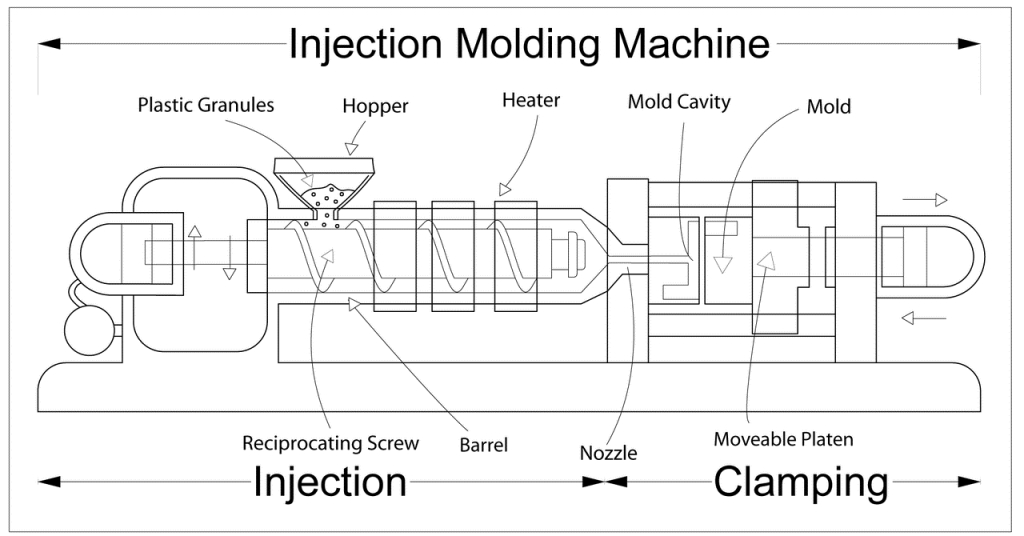
Most of the plastics which are manufactured using the common processes such us extrusion and injection molding are thermoplastics. Out of these the following three kinds are presented below.
POLYETHYLENE
Polyethylene (PE), light, versatile synthetic resin made from the polymerization of ethylene.
Polyethylene is a member of the important family of polyolefin resins. It is the most widely used plastic in the world, being made into products ranging from clear food wrap and shopping bags to detergent bottles and automobile fuel tanks. It can also be slit or spun into synthetic fibres or modified to take on the elastic properties of a rubber.
Chemical composition and molecular structure
Ethylene (C2H4) is a gaseous hydrocarbon commonly produced by the cracking of ethane, which in turn is a major constituent of natural gas or can be distilled from petroleum. Ethylene molecules are essentially composed of two methylene units (CH2) linked together by a double bond between the carbon atoms—a structure represented by the formula CH2=CH2. Under the influence of polymerization catalysts, the double bond can be broken and the resultant extra single bond used to link to a carbon atom in another ethylene molecule. Thus, made into the repeating unit of a large, polymeric (multiple-unit) molecule, ethylene has the following chemical structure:

The red spheres represent carbon atoms while the gray ones represent hydrogen atoms.
This simple structure, repeated thousands of times in a single molecule, is the key to the properties of polyethylene. The long, chainlike molecules, in which hydrogen atoms are connected to a carbon backbone, can be produced in linear or branched forms. Branched versions are known as low-density polyethylene (LDPE) or linear low-density polyethylene (LLDPE); linear versions are known as high-density polyethylene (HDPE) and ultrahigh-molecular-weight polyethylene (UHMWPE).
POLYPROPYLENE
Polypropylene (PP), also known as polypropene, is a thermoplastic polymer used in a wide variety of applications. It is produced via chain-growth polymerization from the monomer propylene.
Polypropylene belongs to the group of polyolefins and is partially crystalline and non-polar. Its properties are similar to polyethylene, but it is slightly harder and more heat-resistant. It is a white, mechanically rugged material and has a high chemical resistance.[1] Polypropylene is the second-most widely produced commodity plastic (after polyethylene).
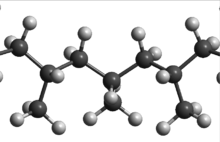
The black balls represent carbon atoms while the white ones represent hydrogen atoms in the following model.
Polyvinyl Chloride (PVC)
Polyvinyl Chloride (PVC or Vinyl) is a high-strength thermoplastic material. It is widely used in applications such as pipes, medical devices, and wire & cable insulation…the list is endless. It is the world’s third-most widely produced synthetic plastic polymer.
Vinyl chloride monomer (VCM) is produced from the chlorination of ethylene and pyrolysis of the resulting ethylene dichloride (EDC) in a cracking unit. PVC is produced by polymerization of vinyl chloride monomer (VCM).
Polyvinyl chloride is produced by polymerization of the vinyl chloride monomer (VCM), as shown below.
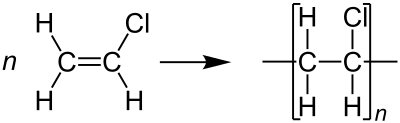
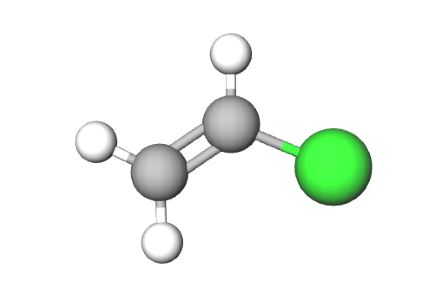
Vinylchloride (chloroethene) monomer: Gray balls joined by a double bond represent carbon atoms. The white balls are for hydrogen atoms while the green represents chlorine.
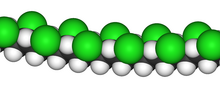
Molecular model of Polyvinylchloride
Polyvinyl Chloride (PVC or Vinyl) is an economical and versatile thermoplastic polymer. It is widely used in the building and construction industry to produce door and window profiles. It also finds use in:
drinking and wastewater pipes, wire and cable insulation, medical devices, etc.
It is the world’s third-largest thermoplastic by volume after polyethylene and polypropylene.
It is a white, brittle solid material available in powder form or granules. PVC is now replacing traditional building materials in several applications. These materials include wood, metal, concrete, rubber, ceramics, etc. This is due to its versatile properties such as:lightweight,durable, low cost, and easy processability.
What are the basic forms of PVC?
Polyvinyl Chloride is widely available in two broad categories: Flexible and Rigid.
Plasticized or Flexible PVC (Density: 1.1-1.35 g/cm3): Flexible PVC is formed by the addition of compatible plasticizers to PVC which lower the crystallinity. These plasticizers act like lubricants resulting in a much clearer and flexible plastic. This type of PVC is sometimes called as PVC-P.
Unplasticized or Rigid PVC (Density: 1.3-1.45 g/cm3): Rigid PVC is a stiff and cost-effective plastic. It shows high resistance to impact, water, weather, chemicals and corrosive environments. This type of PVC is also known as UPVC, PVC-U or uPVC.
| Strengths | Limitations |
| Rigid PVC | |
| Low cost & high stiffness Intrinsic flame retardant FDA compliant & also suitable for transparent applications Better chemical resistance than plasticized PVC Good electrical insulation & vapor barrier properties Good dimensional stability at room temperature | Difficult to melt process Limited solvent stress cracking resistance Becomes brittle at 5°C (when not modified with impact modifiers and/or processing aids) Low continuous service temperature of 50°C |
| Flexible PVC | |
| Low cost, flexible & high impact strength Good resistance to UV, acids, alkalis, oils and many corrosive inorganic chemicals Good electrical insulation properties Non-flammable & versatile performance profile Easier to process than rigid PVC | Properties can change with time, due to plasticizer migration Attacked by ketones; some grades swollen or attacked by chlorinated and aromatic hydrocarbons, esters, some aromatic ethers and amines, and nitro- compounds Tends to degrade at high temperatures Non-suitable for food contact with some plasticizers Lower chemical resistance than rigid PVC |
What are the key properties of PVC?
PVC is a very versatile and cost-effective material. Its main properties and benefits include:
Electrical Properties: PVC is a good insulation material. Thanks to its good dielectric strength.
Durability: PVC is resistant to weathering, chemical rotting, corrosion, shock, and abrasion. It is the preferred choice for many long-life and outdoor products.
Flame Retardancy: Because of its high chlorine content, PVC products are self-extinguishing. Its oxidation index is ≥45. Antimony trioxide has been extensively used in combination with phosphate ester plasticizers. This gives excellent fire performance and mechanical properties.
Cost/Performance Ratio: PVC has good physical as well as mechanical properties. It also provides excellent cost-performance advantages. It has a long life span and needs low maintenance.
Mechanical Properties: PVC is abrasion-resistant, lightweight, and tough.
Chemical Resistance: PVC is resistant to all inorganic chemicals. It has very good resistance against diluted acids, diluted alkalis, and aliphatic hydrocarbons. Some grades are attacked by:ketones and esters,chlorinated and aromatic hydrocarbons,aromatic ethers and amines, andnitro-compounds.